
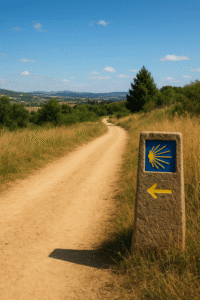
Why We Chose the Camino de Santiago
We’ve traveled extensively around the world, but nothing compared to the experience of walking the Camino de Santiago. And one thing is important to know: there isn’t just one Camino. There are many routes weaving through Europe, forming a vast network of paths—but more on that later.
So why did we choose this journey? In today’s world, filled with endless travel options, the question often isn’t where to go, but why we travel at all. What do we truly want to experience? Sometimes, the answer comes intuitively: someone mentions a place, and suddenly you feel drawn to it. That’s exactly how the Camino found us.
The Camino isn’t just a hike through stunning landscapes. It’s a journey to yourself. In our digital age, where focus is easily lost, it reminds us of what truly matters: the simplicity of life. Every pilgrim walks for different reasons. Some walk for physical challenge, others for nature and peace, while some seek a spiritual experience or want to deepen their faith.
This blog is meant to inspire—but the true experience of the Camino must be lived. It is unique and cannot be predicted. We walked the Camino Francés, the classic route, for the first time, without any expectations—and it exceeded every one of them.
Many people say “strange coincidences” led them to the Camino, or that it was mysteriously recommended to them. In the end, it often feels like the Camino calls you. It deeply touched us: we met incredible people and experienced profound spiritual moments. If you’re considering it, just go. The Camino has a way of staying with you forever.
What Does a “Spiritual Experience” on the Camino de Santiago Mean?
Spiritual experiences on the Camino can take many forms. Some find deep peace in nature; others experience sudden clarity or inspiration. It’s about meeting yourself, letting go, and staying open to whatever the path brings.
After walking the Camino multiple times, you often hear:
“The Camino doesn’t give you what you want, but what you need in this stage of your life.”
“The Camino Provides”
No matter what you need, the Camino ensures you will not leave empty-handed. With trust, it triggers personal growth—sometimes subtly, sometimes almost magically.
- Learn more about how to experience spiritual moments on the Camino here: How to Find Spiritual Experiences on the Camino or WU WEI (無為) – The Flow of Life on the Camino
Preparation – Physically & Spiritually
Physical Preparation on the Camino de Santiago
The Camino is no ordinary hiking trail. It challenges you physically, practically, and emotionally. But how much preparation is really needed? Do you need months of training, or is it enough to simply start walking?
From our experience, if you are reasonably fit and enjoy walking, you don’t need extensive preparation. The Camino itself trains you step by step.
Travel Light on the Camino de Santiago
Our golden rule: carry no more than 10% of your body weight. This has proven the best approach on all our Camino walks.
On later trips, we often overpacked and realized quickly how heavy unnecessary baggage can feel. At the end of the day, it’s not about perfect gear—it’s about walking light and unburdened. For example, if you weigh 60 kg, your backpack should be around 6 kg.
At first, you might think: “I should bring everything—just in case…” But almost every pilgrim eventually learns the freedom of shedding excess weight. Many end up happier and more relaxed after lightening their load.
Training – Necessary or Not?
This topic divides opinions. Some pilgrims do have to quit due to overexertion or lack of fitness. But we believe the key is less about fitness and more about weight carried.
You don’t have to be an athlete to walk the Camino. No one will make you walk faster or farther than you want. In fact, walking slowly—like a snail—is often the best way to truly experience the Camino.
A single 20–25 km practice hike beforehand can give you confidence, but the Camino itself is unlike any ordinary hike. Most importantly, listen to your body. The Camino teaches many lessons—and tuning in to yourself is one of the most urgent.
Shoes & Blister Prevention
A practical tip: break in your shoes before you start. Whether hiking boots or trail runners, comfort, cushioning, and grip matter most.
Blisters are one of the most common issues. Some pilgrims experience them early, others hardly at all. Proper shoes and socks make a huge difference.
Spiritual Preparation for the Camino de Santiago
The Camino is not only about physical endurance. It invites you to walk mindfully, to notice the present moment, and to reflect inwardly. Schedule time for meditation, journaling, or quiet reflection—these moments enhance your spiritual experience.
On the Road – Staying Open to Spiritual Experiences
- Your pace matters: Rest when you need to. The Camino is not a race.
- Community matters: Make time for shared meals or conversations with fellow pilgrims. These encounters often become the most memorable moments.
- Less planning, more trusting: The Camino prepares you, step by step. What matters is openness, listening to your inner voice, and finding your own rhythm.
At the end of the day, it’s not the number of kilometers that counts, but what you experience along the way.
For spiritual inspiration, check out our article on Wu Wei (Flow of Life) on the Camino.
Our 6 Best Tips for Starting Your Camino
- Choose the right shoes: Many pilgrims switch to trail runners after a few days. Pick what feels most comfortable.
- Pack light: Carry only 10% of your body weight.
- Pace & breaks: Walk at your rhythm. Change socks if your feet sweat. Apply blister pads early.
- Sock choice: Hiking socks are sufficient; merino is nice but optional.
- Blister care: Compeed is a lifesaver—worth every penny.
- Enjoy community: Meals or breakfasts with fellow pilgrims often become the most cherished memories.
What is the Camino de Santiago and Why Walk It?
Popularity & Origins
The Camino became widely known in Germany thanks to Hape Kerkeling’s book “Ich bin dann mal weg” and internationally through the Hollywood film “The Way” (starring Martin Sheen).
Today, it’s no longer a hidden secret. Thousands of pilgrims from all over the world walk to Santiago de Compostela each year.
In 2009, about 145,000 pilgrims received their official Compostela certificate; by 2024, that number had grown to 499,239, with 519,449 registered by October 2024 alone.
On the Camino, you meet people from every continent—Australia, Korea, Japan, the USA, and across Europe.
Originally, it was purely a religious pilgrimage, leading to Santiago de Compostela in northwest Spain, where legend holds that the remains of Saint James the Apostle are buried.
- Read about the growing Camino pilgrimage trend and its effects written in the Times: Camino de Santiago breaks record numbers
Even with crowds, the Camino Francés remains worth walking.
Spiritual History & Origins
According to legend, Saint James preached in Jerusalem and was executed around 44 AD. His followers placed his body in a boat without sails or oars. Guided by a divine light and angels, it miraculously reached Galicia in northwest Spain.
Centuries later, around 813, a shepherd named Pelayo saw glowing lights pointing to a location. Upon investigation by the bishop and clergy, a stone tomb containing three bodies—including Saint James—was discovered.
King Alfonso II visited personally, becoming the first pilgrim, and had a chapel built over the tomb, which later became the Cathedral of Santiago de Compostela.
Spiritual Meaning & Motives
Today, pilgrims walk for many reasons: faith, spirituality, physical challenge, or love of nature.
From our experience, the Camino is a healing journey—a path to self-discovery and inner truth.
You don’t need to know why you walk; the most important thing is to take the first step.
The Camino is a form of meditation in motion. Old emotions may resurface—grief, loss, or feelings long unprocessed. Nature and solitude bring clarity, while encounters with strangers can lead to lasting friendships.
On the Camino, everything finds its place.
∞ Whatever you need, will come to you.